
A hot afternoon in Kerrville with an air conditioner that will not start, a refrigerator that quits overnight at a campground, or a slide-out that will not retract before checkout can turn a good RV trip into a stressful one fast. Knowing how to troubleshoot RV systems calmly can help you identify a simple reset or loose connection, protect your equipment, and explain the problem clearly if you need a technician.
The goal is not to take apart every component. RV systems overlap in ways that can make a small issue look larger than it is. Start with safe, basic checks, pay attention to what changed before the failure, and stop before a repair puts you, your passengers, or the RV at risk.
Start RV Troubleshooting With Safety and the Basics
Before checking anything, make the area safe. If you smell propane, see smoke, smell burning plastic, notice sparking, or have a suspected electrical shock hazard, shut off the source if you can do so safely, get everyone outside, and seek immediate professional help. Do not test LP gas leaks with a flame. Do not continue resetting breakers that trip repeatedly.
For ordinary problems, begin with the same three questions: What is not working? What still works? What changed just before the problem started? Those answers narrow the search quickly. A refrigerator and microwave that are both off point toward incoming power. A refrigerator that is off while the outlets work points more toward the appliance, its mode setting, fuse, or dedicated circuit.
Check your RV’s battery disconnect switch, main breaker panel, fuse panel, shore-power connection, and monitor panel. A loose shore cord, campground pedestal breaker, tripped GFCI outlet, depleted battery, or accidentally switched-off battery disconnect causes more service calls than many owners expect.
It also helps to slow down before pressing reset buttons. Turn a system off, wait a minute, then restore power once. If it immediately trips, shuts down, or displays an error again, leave it off. Repeated resets can damage equipment and hide the real cause.
How to Troubleshoot RV Electrical Problems
Electrical issues are often the first place to look because nearly every comfort system depends on power. Start by identifying your power source: shore power, generator, house batteries, or tow-vehicle power. Your RV may operate differently on each source.
If the whole coach seems dead while plugged in, check that the campground pedestal breaker is on, the cord is fully seated and undamaged, and the RV’s main breaker has not tripped. If you use an adapter, inspect it for heat damage or looseness. A warm plug is a warning sign; a hot, discolored, or melted plug needs attention before it becomes a fire risk.
If 12-volt lights, water pump, vent fans, or control panels are weak or dead, check the battery disconnect and battery condition. A battery can show some voltage yet lack enough capacity to run a load. Corroded terminals, a loose ground cable, and a failed converter are common causes of low-voltage trouble.
A useful clue is whether the issue changes when shore power is connected. If 12-volt equipment works only while plugged in, the batteries may be discharged or failing. If it works on batteries but not when connected to shore power, the converter, breaker, cord, or pedestal may be the problem. Avoid probing live wiring unless you are trained and have the correct meter.
Check GFCI Outlets Before Assuming a Circuit Failed
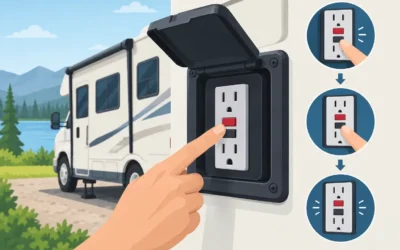
Many RV outlets are protected by a single GFCI receptacle, often in the bathroom, kitchen, exterior compartment, or near the sink. One tripped GFCI can shut down several outlets that seem unrelated. Reset it once after unplugging connected appliances. If it will not reset or trips again, stop using that circuit until it can be diagnosed.
Cooling, Heating, and Refrigerator Checks
Texas Hill Country weather makes climate-control failures more than an inconvenience. Before calling for air conditioner service, confirm you have adequate shore power or generator capacity. Many RV air conditioners need a strong 120-volt supply, and a weak campground connection or undersized generator can prevent startup.
Set the thermostat several degrees below the interior temperature, make sure it is in cooling mode, and check the appropriate breaker. Listen for what happens next. Does the thermostat click? Does the fan run without cold air? Does the unit hum and then shut off? Those details matter.
A dirty return-air filter can reduce airflow and contribute to freeze-ups. Clean or replace a washable filter according to the manufacturer instructions, but do not remove rooftop covers or open electrical compartments while power is connected. If the breaker trips, the compressor will not start, or the unit is leaking water inside, shut it down and arrange service.
For a furnace, make sure there is propane in the tank, the LP valve is open, the battery voltage is adequate, and exterior furnace vents are clear of mud-dauber nests, leaves, and debris. Furnaces need 12-volt power even when they run on propane. If you smell raw propane, hear repeated failed ignition attempts, or the furnace cycles without producing heat, do not keep trying to light it.
RV refrigerators deserve a careful approach. First, verify the selected operating mode. Some models can run on shore power, generator power, propane, or battery-supported compressor systems. Check that the RV is reasonably level, the exterior refrigerator vents are open, and the unit has not been switched off at its control panel. A refrigerator that is running but not cooling may need more than a reset, especially if it has a fault code, yellow residue around the cooling unit, or a strong ammonia smell.
Find Water and Plumbing Problems Early
Water leaks can cause expensive damage long before they become obvious. If you see water inside, turn off the water pump and disconnect city water if possible. Then dry the area and look for the source: a loose fitting under the sink, toilet valve, water heater connection, shower line, or split pipe are all possibilities.
If the pump runs continuously when no faucet is open, the system is losing pressure. Look for drips inside cabinets, around the water heater, beneath the RV, and near the fresh-water tank. A pump that will not run may be a blown fuse, low battery voltage, an off switch, or a clogged inlet screen.
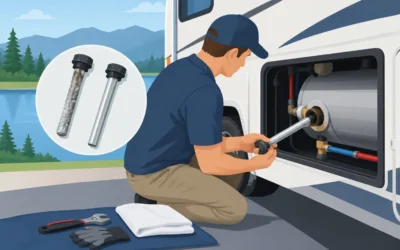
For no hot water, check the water heater’s energy source and controls. Electric and propane functions may be separate. Confirm the water heater tank is full before using its electric heating element. Running an electric element in an empty tank can burn it out quickly. If you see water pooling around the heater, smell gas, or find soot near the exterior access area, stop and have it inspected.
Handle Slide-Out and Leveling Issues Without Forcing Them
When a slide-out will not move, stop before using force. Make sure the battery voltage is strong, the parking brake and ignition settings meet your RV’s requirements, and no travel lock is engaged. Check for obvious obstructions inside and outside, including rugs, cabinet doors, branches, or stored gear.
A slide that moves slowly or clicks may be dealing with low voltage, a binding mechanism, a failed motor, or a control issue. Do not repeatedly hold the switch after motion stops. That can strain the motor or gears. Most RVs have a manual override procedure, but it varies by manufacturer and can cause damage if used incorrectly. Use it only with the correct instructions for your model.
The same caution applies to leveling jacks. Confirm the ground is stable, remove anything blocking jack movement, and inspect for visible hydraulic fluid. If a jack is crooked, leaking, or will not retract, avoid travel until the situation is evaluated. Driving with equipment hanging down can create a much larger repair.
When a Mobile RV Technician Is the Right Next Step
Basic troubleshooting is valuable when it saves time and prevents a simple issue from becoming worse. But some problems need tools, testing experience, and a safe repair environment. Call for service when a breaker keeps tripping, batteries will not charge, propane equipment fails to ignite, a refrigerator shows a fault code, a water leak is hidden, an air conditioner will not cool, or a slide-out will not operate normally.
Before you call, have your RV year, make, model, system brand, and symptoms ready. Take note of any error codes and whether the problem happens on shore power, generator power, battery power, or all three. Photos of a leaking fitting, a damaged cord, or a display message can also speed up diagnosis.
For RV owners parked in Fredericksburg, Bandera, Comfort, Ingram, Center Point, Kerrville, and nearby Hill Country locations, Mobile RV Solutions can bring diagnostics and repair work to your campsite, property, or roadside location. That means less time arranging a tow or trying to drive an RV with a problem that should be addressed where it sits.
Your RV does not have to be perfect to keep traveling, but it does need to be safe, powered, and comfortable. A few careful checks can give you a clear next step – and knowing when to stop is often the smartest repair decision you can make.
0 Comments