
A tripped RV breaker can look like a small inconvenience until the air conditioner quits during a Hill Country afternoon, the refrigerator loses power, or you smell hot plastic near the electrical panel. Knowing how to inspect RV breakers can help you restore a simple overload safely and recognize when the problem needs professional attention before it damages equipment or creates a fire risk.
Your RV has more than one electrical system, and the breaker panel is only part of the picture. A careful inspection starts with safety, then moves from the obvious checks to the warning signs that should stop the job in its tracks.
Start With a Safe RV Breaker Inspection
Before touching the electrical panel, turn off or unplug the appliances that were running when the power failed. Air conditioners, space heaters, microwaves, coffee makers, hair dryers, and electric water-heater elements can draw enough power to overload an RV circuit, especially when more than one high-demand appliance is operating at once.
Keep your hands dry, stand on a dry surface, and use a flashlight rather than trying to inspect a dark compartment by feel. Do not open the breaker-panel cover beyond its normal door or remove the panel face to inspect wiring. The wires and connections behind that cover can remain energized even when individual breakers are off.
If you see melted plastic, black marks, corrosion, water around the panel, loose parts, or a breaker that feels unusually hot, do not reset anything. Disconnect shore power if it is safe to do so, shut down the generator, and arrange for an RV electrical technician to inspect the system.
Know Which RV Power System You Are Checking
Most RVs use a 120-volt AC system for household-style appliances and outlets. This is the system controlled by the breakers in your main electrical panel. It operates from shore power, a generator, or an inverter in some setups.
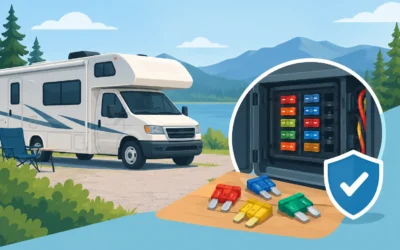
Your RV also has a 12-volt DC system that runs items such as interior lights, vent fans, water pumps, furnace controls, and many refrigerator control boards. That system is normally protected by fuses, not standard breakers. If your ceiling lights and water pump are out but the microwave still has power, the issue may be a battery, fuse, converter, or battery disconnect rather than an AC breaker.
Some RVs also have GFCI outlets, usually in the kitchen, bathroom, exterior compartment, or near wet areas. A tripped GFCI can shut off several downstream outlets even though every breaker in the panel appears normal. Check and reset the GFCI only if the outlet is dry and there are no signs of damage.
How to Inspect RV Breakers Step by Step
Open the panel door and look at every breaker handle. A tripped breaker may sit in a middle position rather than fully in the OFF position. On some panels, it may appear almost on but will not stay there when reset.
First, identify the breaker for the circuit that lost power. Labels are helpful, but do not assume they are perfect, particularly in an older RV or one that has had previous repairs. Turn the suspected breaker firmly all the way to OFF, then turn it back to ON. Simply pushing a tripped breaker toward ON without first moving it fully to OFF may not reset it.
Once reset, wait a moment before turning appliances back on. Restore loads one at a time. If the breaker stays on until you start the microwave, air conditioner, space heater, or water heater, you have narrowed down the load causing the trip. If it trips with everything unplugged and switched off, the issue could be a damaged outlet, failing appliance, loose connection, shorted wire, or defective breaker.
Do not keep resetting a breaker that trips repeatedly. A breaker is doing its job when it opens a circuit that is overloaded or unsafe. Repeated resets can turn a manageable electrical problem into damaged wiring or a burned connection.
Check the Main Breaker Too
If the entire RV has lost 120-volt power, inspect the main breaker in addition to the individual branch breakers. A main breaker can trip because of an overload, a generator issue, a shore-power problem, or a fault inside the RV.
Before assuming the RV is at fault, check the power pedestal. A campground pedestal breaker may have tripped, or the outlet may have a weak or damaged connection. If you have access to a properly rated RV surge protector or electrical management system, its display can sometimes point to low voltage, high voltage, reverse polarity, or an open ground. Those conditions should be addressed before you reconnect.
On private property or remote acreage, a long extension cord, undersized wiring, or a heavily loaded household outlet can create voltage drop. Low voltage is especially hard on air conditioner compressors. If your air conditioner struggles to start, lights dim, or the plug feels warm, stop using that power source and have it checked.
Warning Signs That Call for a Technician
A breaker trip after running too many appliances may be straightforward. The following signs are different. They point to a condition that should be diagnosed instead of reset:
- The breaker trips immediately with appliances unplugged or turned off.
- The panel, breaker, outlet, plug, or shore-power cord feels hot.
- You smell burning insulation or see discoloration, soot, melting, or arcing marks.
- Power cuts in and out without a breaker clearly tripping.
- The breaker handle will not stay on, feels loose, or makes a buzzing sound.
- Rain, a plumbing leak, or condensation may have reached the panel or nearby outlets.
- Your generator runs, but the RV has no usable power or only partial power.
A hot breaker or hot shore-power connection deserves prompt attention. Heat usually means resistance at a connection, and resistance can worsen quickly under a heavy load. This is particularly common at worn pedestal receptacles, damaged plugs, loose neutral connections, and older RV panels.
Avoid the Most Common Reset Mistakes
The biggest mistake is treating the breaker as the problem rather than a protective device. A breaker that trips is often responding to a load issue somewhere else. Replacing it without testing the circuit can hide the warning without fixing the cause.
Avoid running two major heat-producing appliances on the same circuit. In many RVs, a portable heater and a hair dryer together can exceed the circuit limit. The same goes for a microwave and electric water heater, depending on the RV’s wiring and available service. A 30-amp RV has far less room for simultaneous high-demand appliances than a 50-amp RV, although even a 50-amp coach can have overloaded individual branch circuits.
Do not use household-style extension cords as a permanent solution for shore power. The cord must be properly rated for the load and kept as short as practical. A light-duty cord may work briefly for low-demand items, but it is not appropriate for powering an RV air conditioner, water heater, or multiple appliances.
Also, do not ignore a breaker that trips only when it is very hot outside. High outdoor temperatures often mean the air conditioner is working harder, and campground voltage can drop as more rigs run their systems. The pattern may be useful diagnostic information, but it is not a reason to keep forcing the circuit back on.
When Mobile RV Electrical Service Makes Sense
A basic breaker reset is reasonable when you clearly identify an overload and the breaker stays on after you reduce the load. Anything less clear calls for diagnosis. RV electrical issues can involve the breaker panel, converter, inverter, transfer switch, generator, shore-power cord, GFCI circuit, batteries, or the appliance itself. These systems affect each other, which is why a quick guess can lead to unnecessary parts replacement.
For RV owners parked in Fredericksburg, Kerrville, Bandera, Comfort, Ingram, Center Point, or surrounding Texas Hill Country areas, Mobile RV Solutions can inspect the electrical system where the RV is parked. That can save the trouble of towing a coach with an active electrical concern to a repair facility, especially when reliable power is needed for cooling, refrigeration, or safe overnight living.
A good service call begins with the details you noticed: which breaker tripped, what was running, whether the issue began on shore power or generator power, and whether there was heat, odor, or flickering. Those observations help a technician reach the cause faster.
If a reset restores power and stays stable, use the circuit thoughtfully and keep an eye on it. If the breaker trips again, gets warm, or leaves you uncertain about what is happening behind the panel, stopping early is the practical choice that protects both your RV and your trip.
0 Comments